Tirzepatide reconstitution chart
Six vial sizes, four water volumes, the concentration of each combination and the units for every rung of the 2.5 to 15 mg ladder.
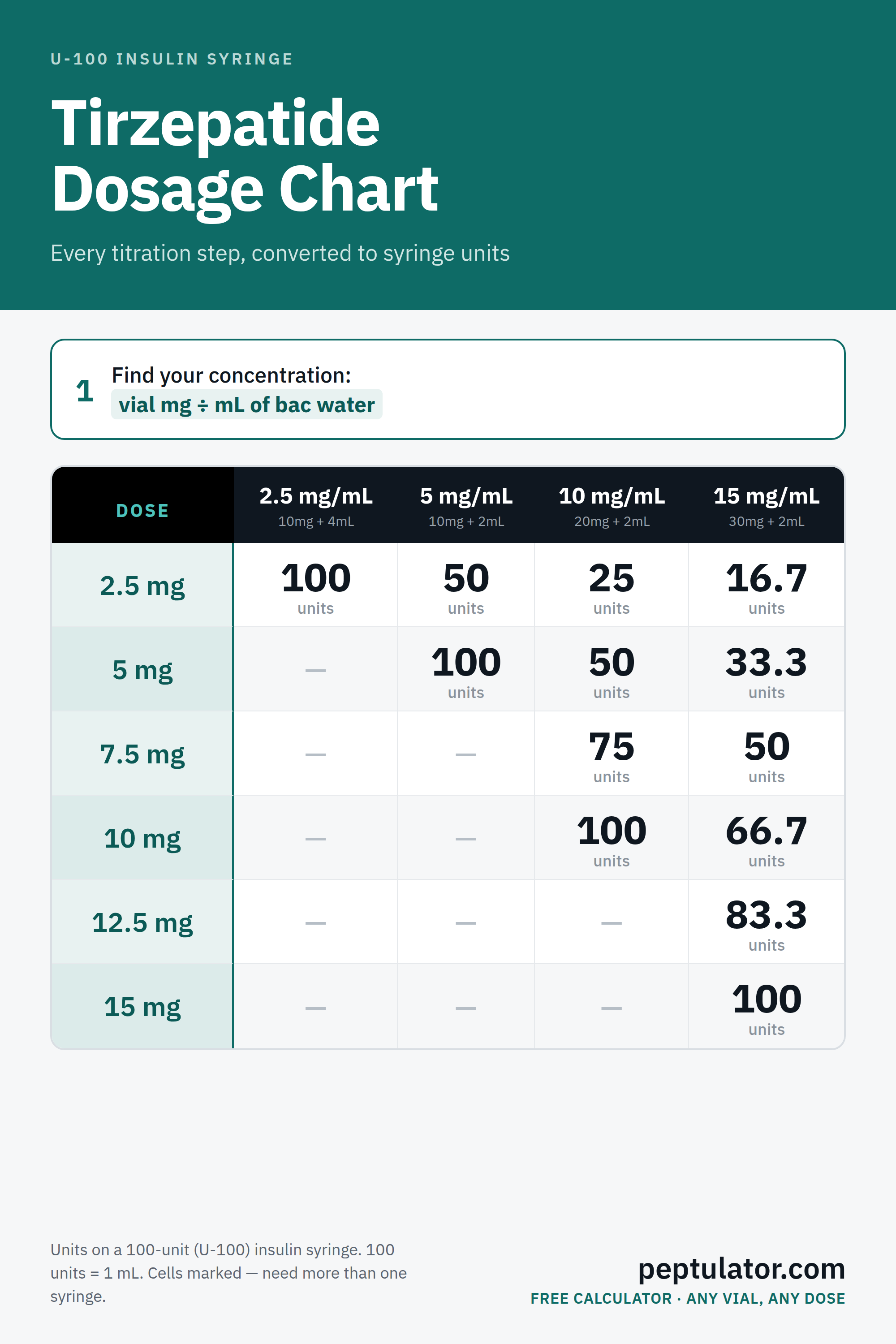
Tirzepatide vials come in 5, 10, 15, 20, 30 and 60 mg. The water you add sets the concentration, and the concentration sets how many units each rung of the 2.5 to 15 mg ladder needs. This chart gives every combination so you can pick a water volume that keeps your dose readable and inside one syringe.
Concentration for every vial and water volume
| Vial | 1 mL | 2 mL | 3 mL | 4 mL |
|---|---|---|---|---|
| 5 mg | 5 mg/mL | 2.5 mg/mL | 1.67 mg/mL | 1.25 mg/mL |
| 10 mg | 10 mg/mL | 5 mg/mL | 3.33 mg/mL | 2.5 mg/mL |
| 15 mg | 15 mg/mL | 7.5 mg/mL | 5 mg/mL | 3.75 mg/mL |
| 20 mg | 20 mg/mL | 10 mg/mL | 6.67 mg/mL | 5 mg/mL |
| 30 mg | 30 mg/mL | 15 mg/mL | 10 mg/mL | 7.5 mg/mL |
| 60 mg | 60 mg/mL | 30 mg/mL | 20 mg/mL | 15 mg/mL |
The ladder in units, by vial and water
Bold rows fit a 1 mL syringe across the whole ladder. Where a dose exceeds 100 units you need less water or a second injection.
5 mg vial
| Water | Conc. | 2.5 mg | 5 mg | 7.5 mg | 10 mg | 12.5 mg | 15 mg |
|---|---|---|---|---|---|---|---|
| 1 mL | 5 mg/mL | 50 | 100 | - | - | - | - |
| 2 mL | 2.5 mg/mL | 100 | 200* | - | - | - | - |
| 3 mL | 1.67 mg/mL | 150* | 300* | - | - | - | - |
| 4 mL | 1.25 mg/mL | 200* | 400* | - | - | - | - |
10 mg vial
| Water | Conc. | 2.5 mg | 5 mg | 7.5 mg | 10 mg | 12.5 mg | 15 mg |
|---|---|---|---|---|---|---|---|
| 1 mL | 10 mg/mL | 25 | 50 | 75 | 100 | - | - |
| 2 mL | 5 mg/mL | 50 | 100 | 150* | 200* | - | - |
| 3 mL | 3.33 mg/mL | 75 | 150* | 225* | 300* | - | - |
| 4 mL | 2.5 mg/mL | 100 | 200* | 300* | 400* | - | - |
15 mg vial
| Water | Conc. | 2.5 mg | 5 mg | 7.5 mg | 10 mg | 12.5 mg | 15 mg |
|---|---|---|---|---|---|---|---|
| 1 mL | 15 mg/mL | 16.7 | 33.3 | 50 | 66.7 | 83.3 | 100 |
| 2 mL | 7.5 mg/mL | 33.3 | 66.7 | 100 | 133.3* | 166.7* | 200* |
| 3 mL | 5 mg/mL | 50 | 100 | 150* | 200* | 250* | 300* |
| 4 mL | 3.75 mg/mL | 66.7 | 133.3* | 200* | 266.7* | 333.3* | 400* |
20 mg vial
| Water | Conc. | 2.5 mg | 5 mg | 7.5 mg | 10 mg | 12.5 mg | 15 mg |
|---|---|---|---|---|---|---|---|
| 1 mL | 20 mg/mL | 12.5 | 25 | 37.5 | 50 | 62.5 | 75 |
| 2 mL | 10 mg/mL | 25 | 50 | 75 | 100 | 125* | 150* |
| 3 mL | 6.67 mg/mL | 37.5 | 75 | 112.5* | 150* | 187.5* | 225* |
| 4 mL | 5 mg/mL | 50 | 100 | 150* | 200* | 250* | 300* |
30 mg vial
| Water | Conc. | 2.5 mg | 5 mg | 7.5 mg | 10 mg | 12.5 mg | 15 mg |
|---|---|---|---|---|---|---|---|
| 1 mL | 30 mg/mL | 8.3 | 16.7 | 25 | 33.3 | 41.7 | 50 |
| 2 mL | 15 mg/mL | 16.7 | 33.3 | 50 | 66.7 | 83.3 | 100 |
| 3 mL | 10 mg/mL | 25 | 50 | 75 | 100 | 125* | 150* |
| 4 mL | 7.5 mg/mL | 33.3 | 66.7 | 100 | 133.3* | 166.7* | 200* |
60 mg vial
| Water | Conc. | 2.5 mg | 5 mg | 7.5 mg | 10 mg | 12.5 mg | 15 mg |
|---|---|---|---|---|---|---|---|
| 1 mL | 60 mg/mL | 4.2 | 8.3 | 12.5 | 16.7 | 20.8 | 25 |
| 2 mL | 30 mg/mL | 8.3 | 16.7 | 25 | 33.3 | 41.7 | 50 |
| 3 mL | 20 mg/mL | 12.5 | 25 | 37.5 | 50 | 62.5 | 75 |
| 4 mL | 15 mg/mL | 16.7 | 33.3 | 50 | 66.7 | 83.3 | 100 |
Units on a standard U-100 insulin syringe. * means more than 100 units, so more than one 1 mL syringe. A dash means the dose is larger than the vial.
Reading the chart
A 30 mg vial with 3 mL is the setup most people land on: 10 mg/mL, so the ladder runs 25, 50, 75, 100, 125 and 150 units. Fine up to 10 mg, then it outgrows the syringe. Reconstituting the same vial with 2 mL (15 mg/mL) brings 15 mg down to 100 units. A 5 mg vial is two 2.5 mg starting doses and nothing else, whatever the water. Write the water volume on the vial; the chart is useless a week later if you cannot remember which row you are on.
25 printable pages: dosing cards for the twelve most-used compounds at three water volumes, titration planners, a vial log, and five pages on what to do when it has already gone wrong.
Common questions
- How much bacteriostatic water do I add to a 30 mg tirzepatide vial?
- 3 mL is the common choice and gives 10 mg/mL, so 2.5 mg is 25 units and 10 mg is 100 units. If you are running 12.5 or 15 mg, 2 mL keeps those doses inside one syringe.
- How many units is 5 mg of tirzepatide?
- At 10 mg/mL (30 mg in 3 mL), 50 units. At 5 mg/mL (10 mg in 2 mL), 100 units. At 15 mg/mL (30 mg in 2 mL), 33.3 units. The vial and the water decide it, not the dose alone.
- Can I use the chart for a pen?
- No. Pens are a fixed concentration set by the manufacturer and are dosed by the pen's own dial. This chart is for lyophilised vials you reconstitute yourself.
All calculators and charts
Weight management (GLP-1 family)
- Retatrutide calculator Vial, water and weekly dose to syringe units
- Tirzepatide calculator The 2.5 to 15 mg ladder, converted
- Semaglutide calculator The 0.25 to 2.4 mg ladder, converted
- Cagrilintide calculator Amylin analogue, 0.3 to 4.5 mg weekly
Growth hormone axis
- HGH (somatropin) calculator IU vials to syringe units
- Ipamorelin calculator mcg doses, in mL and units
- CJC-1295 (no DAC) calculator No-DAC and DAC, mcg to units
- CJC-1295 / Ipamorelin blend calculator The 5 mg + 5 mg blend, per component
- Sermorelin calculator Nightly mcg doses to units
- Tesamorelin calculator 1 to 2 mg daily, in units
- Hexarelin calculator mcg doses to units
- IGF-1 LR3 calculator Tens of mcg from very small vials
- AOD-9604 calculator 300 mcg daily, in units
- MOTS-c calculator 5 to 10 mg, two or three times a week
Repair, skin and blends
- BPC-157 calculator mcg doses from a 5 or 10 mg vial
- TB-500 calculator Loading and maintenance, in units
- BPC-157 / TB-500 blend calculator The Wolverine stack, per component
- GHK-Cu calculator 50 to 200 mg vials, mg doses
- GLOW blend calculator The 70 mg blend, split per component
- KLOW blend calculator The 80 mg blend, split per component
Other compounds
- PT-141 calculator 0.5 to 2 mg, as needed
- Melanotan II calculator mcg loading doses to units
- NAD+ calculator 100 to 1,000 mg vials, 25 to 200 mg doses
- Thymosin alpha-1 calculator 1.6 mg twice weekly, in units
- Epitalon calculator Short courses of 5 to 10 mg
- Kisspeptin-10 calculator mcg doses to units
- Glutathione calculator Hundreds of mg, or a 200 mg/mL solution
Dosage charts and schedules
- Peptide reconstitution chart Concentration for every vial and water combination
- Peptide dosing chart Printable unit tables for every compound
- Retatrutide titration schedule 2 to 12 mg in units, stage by stage
- Tirzepatide titration schedule 2.5 to 15 mg in units, stage by stage
- Semaglutide titration schedule 0.25 to 2.4 mg in units, stage by stage
- KLOW dosage and frequency chart The 80 mg blend at 2, 3 and 4 mL, both phases
- GLOW dosage chart The 70 mg blend, units to each peptide
- Wolverine stack dosing chart BPC-157 + TB-500, blend and separate vials
- MOTS-c dosage chart 5 and 10 mg vials at three water volumes
- Tirzepatide reconstitution chart (this page)
- Retatrutide dosing chart 1 to 12 mg across 10, 20 and 30 mg vials
- Printable dosing charts Four one-page charts to save, pin or print
Tools
- Peptide calculator The general tool, any compound
- Reconstitution calculator How much water to add, and why it matters
- mg to units calculator Both directions, any concentration
- Bacteriostatic water calculator Pick a volume that lands where you can read it
- How to read an insulin syringe U-100 vs U-40, and the 2.5x error
- The Protocol Pack Free 25-page printable reference
- Where to buy Vendor notes and what to check first
- 1 mg to units on an insulin syringe The conversion table for every common concentration